

THE CONTEXT LAYER IN ACTION
From source to approved action.
 Watch the demo · 0:50
Customer context across chat, tickets, wiki and CRM. Inspect sources, then approve actions.
Read the full case study →The context layer joins your chat, tickets, wiki, CRM and meetings into one model of the business, and hands every role the context it needs, with the source. Here is what that looks like at their desks.
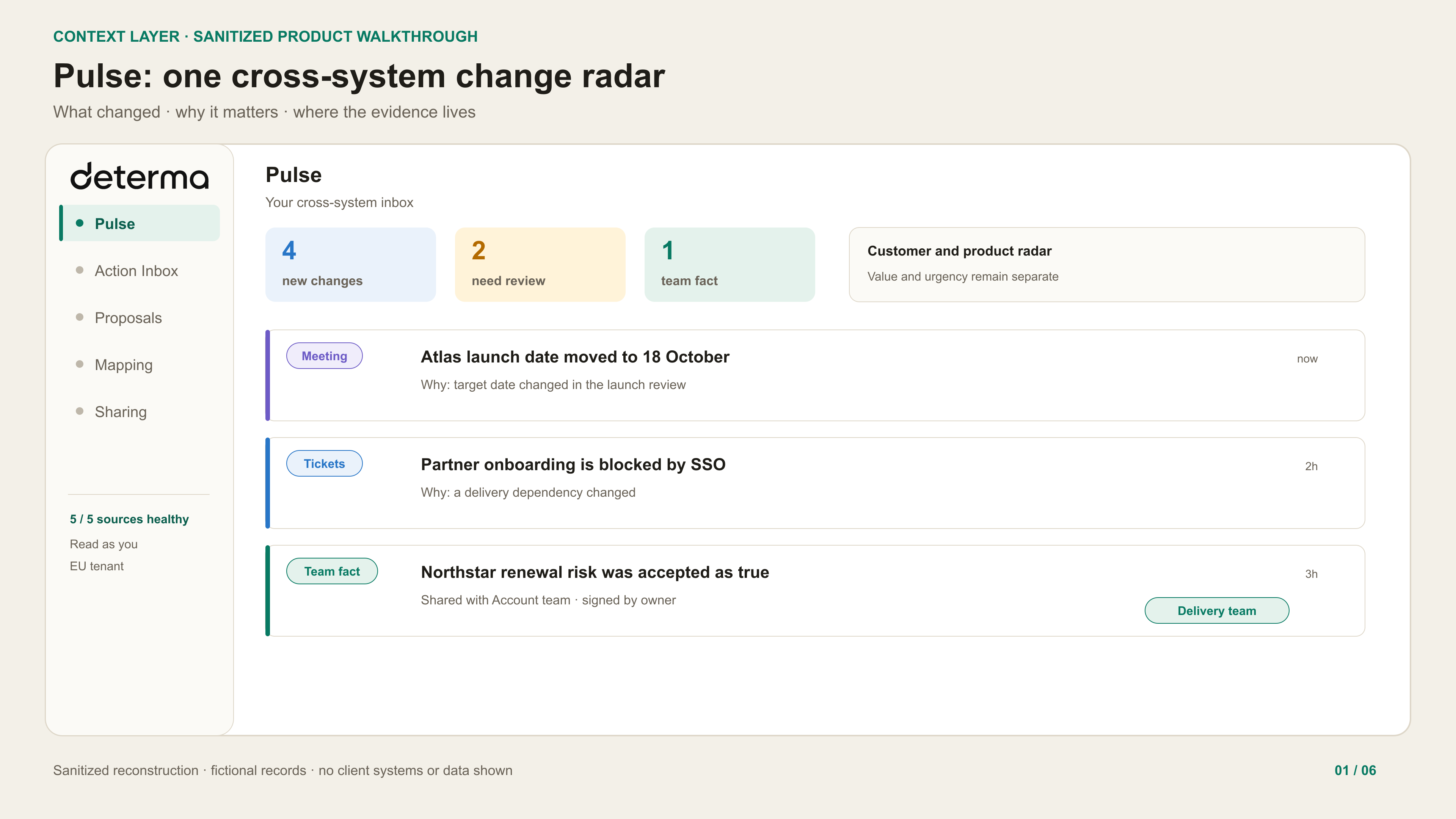
One short brief at the start of the day: what moved with your customers across chat, tickets, wiki, CRM and meetings, every line with its source. Someone who was not in the meeting learns what was decided without asking anyone who was.
What changed since you last looked, folded per customer, the mention cited or the item dropped. 1 day at minimum, 7 at most, so a week away is caught up instead of silently lost. A source that did not answer is named, so a quiet radar and a failed read never look the same.
The meeting is written up while it runs: notes, decisions, who agreed to do what. Each decision lands in your proposals, one row at a time, to accept, edit or decline. Colleagues get the write-up, never the transcript.
CRM stage and close date right beside the ticket that holds up the go-live. The question no single system answers, answered in one place, with both sources.
Ask about a customer, a page, a decision. The answer cites where it comes from, shows only what you may see, and says “not found” instead of inventing one.
Comment on the ticket, append to the wiki page, reply in the thread, create a work item, all as yourself. Nothing is written until you tap approve. Every tap leaves a receipt, and a decline is an audited decision too.
It runs in your company’s cloud tenant, with model processing locations verified for each deployment. Answers are trimmed per person, no external action runs without authorization, and every step is audited. Production-ready before anyone says yes.
The same backend over MCP, inside Claude, Codex and any MCP-enabled app. Same identity, same approval gate, same audit trail as in chat. Nothing new to govern.
RECEIPT r-2291
comment · ticket 218
as M. Keller · 09:42
audited ✓
MKCan the bulk import go in before go-live?
HKWe have 1,200 legacy items.
SBThen go-live in week 41, not 40.
MKSpec comes by Friday.
Helio asked whether the import can take 1,200 legacy items before go-live.
›Where do we stand with Helio?
⏺ context.search("Helio")
⎿ 3 facts · meeting 3 Sep · ticket 218 · CRM
›Comment that on ticket 218.
⏺ context.propose(ticket: 218)
⎿ pending · same gate as in chat
✓ approved by M. Keller · receipt r-2292
Wherever someone needs to know what was said, decided or changed, and act on it with a person in charge.
Every shared fact carries a recorded consent. Nothing becomes company knowledge until a person confirms it.
7 days of changes, folded per customer, instead of a wall of unread messages.
The brief before the meeting: what is open with this customer, and who said it.
Ticket, chat mention and last call about one customer in one answer. The reply goes out as you, after approval.
Every approval, every decline, every receipt, traceable to a person and a time.
Blocked tickets next to the date promised to the customer, before the customer asks.
The roles change. The model of the business underneath stays the same: sourced, permissioned, approved.
Scenes are synthetic: real surfaces, fictional customers, people and records.
Watch the demo · 0:50Customer context across chat, tickets, wiki and CRM. Inspect sources, then approve actions.
Read the full case study →As of 09:00: launch on 12 October.As of 11:30: launch on 19 October.
The agreed change takes effect at 11:30. The earlier commitment and both sources stay traceable.
Fictional example · reviewed customer call
Founded and led by René Zander · Enterprise AI Architect · 19 years of enterprise IT
Why René Zander stands behind it

Determa grew out of 19 years of enterprise IT — out of projects where systems had to do more than work: they had to survive operation, pass review, and be handed over. René Zander leads every Determa engagement personally: architecture, guardrails, handover. No sales team promising something a delivery team has to keep later.
References, case studies and a full sample scope for production operation remain on renezander.com. Determa delivers the engagements.
René Zander leads Determa and takes responsibility for architecture, implementation and handover.
Next step
In a free 30-minute call we establish where your initiative stands and which next step makes sense — or why you do not need one right now.
The calendar loads only after you click. Until then no data is sent to third parties.
The calendar could not be loaded — book directly in the browser or write to [email protected].